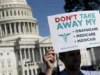
President Trump recently issued a stark warning that he plans to cut major federal safety-net programs — including Medicare, Medicaid, and Social Security — in order to fund other priorities such as tax cuts and enhanced border security. The comment triggered an immediate wave of reactions from the American public, analysts and policy-organizations alike. According to reporting by Yahoo News, Trump said these programs were “on the table” for reduction despite previous pledges to leave them untouched.
Public-opinion data show broad and deep concern. A survey by the Navigator Research found that a large majority of Americans oppose cuts to Social Security (85 %), Medicare (85 %), and Medicaid (81 %) when those cuts are used to fund tax breaks or other spending priorities.
Regional focus-group work by the Kaiser Family Foundation (KFF) further reveals that even voters who supported Trump or voted Republican expressed strong unease about potential reductions to Medicaid coverage. These studies show that individuals on Medicaid, or whose families use the programs, fear major disruptions to their health care access.
Meanwhile, older Americans — those most dependent on Social Security — show rising anxiety about the program’s future. An AP-NORC poll indicated that nearly 30% of adults aged 60 or older are “not very” or “not at all” confident that Social Security will be available when they need it, up from about 20% two years earlier. The decline was especially pronounced among older Democrats.
Across the political spectrum, the threat of cuts is galvanizing mobilization: advocacy groups focused on retirees, disability rights, and healthcare are increasing public-awareness campaigns and calling on lawmakers to commit to protecting entitlements. The reaction is not only about fear—it is also about political consequence: many Americans view these programs as among the last reliable federal supports, and their potential erosion is being framed as a litmus test in the upcoming 2026 midterms.

Why It Matters
Safety-net trust at risk — These programs are pillars of American social policy; even announcing their possible reduction shakes public confidence.
Political accountability — Because many voters rely on these benefits, the threat of cuts raises the stakes for elected officials ahead of future elections.
Fiscal vs social trade-off highlighted — The debate underscores a core tension: tax cuts and border security vs preserving support for vulnerable populations.
Policy adoption behavior — When citizens believe entitlements are in jeopardy, it can shift their voting behavior, activism, and engagement with government.
Generational equity concerns — Younger and older Americans both worry: older people fear benefit loss, younger people fear poorer healthcare access or heavier tax burdens.

Key Social Outcome
Elevated public anxiety — Many Americans now openly question whether Medicare, Medicaid and Social Security will still be there in the form they know, increasing personal and household uncertainty.
Grass-roots mobilization — Advocacy groups, community organizations and union retirees are organizing “protect our programs” campaigns and messaging, boosting civic engagement around entitlements.
Shift in voter priorities — Programs like these are becoming front-and-center issues for voters, especially older adults, retirees and low-income families, which may influence mid-term election outcomes.
Stigmatization of cuts — Talking about cuts to these programs is increasingly seen as politically risky; the public mood is aligning against reductions, making it harder for policymakers to advocate cuts without backlash.
Cross-partisan concern — Even voters who supported Trump or Republicans express concern about these cuts, indicating that the issue transcends typical partisan divides and could reshape coalition alignments.